Humanita
Early researchAI research · September 2026 – now · introductory demo planned for December 18, 2026
An early research project about building a helpful, safe AI, starting with a tiny one.
A research program, not a released product. A private, offline Humanita assistant runs only on my Mac, for testing.
Humanita is a research program I founded. The goal is an AI that helps people, avoids harm and always keeps humans in control. So far it has a tiny teaching model that learned simple letter patterns, a locked-down practice lab, and a detailed safety plan.
My role: Founder and director: purpose, safety rules and every major decision, plus guided, hands-on setup of the protected lab. Codex (an AI coding assistant) wrote and tested the teaching model under my direction.
Founded and directed the Humanita research program; performed guided encrypted-lab setup; used Codex to implement and verify a bounded original teaching network.
Highlights
Starts with a tiny model anyone can inspect.
A private offline assistant, tested in a locked-down Mac app.
A 37-page safety plan with 40 checks.
Starting with something tiny anyone can inspect.
Humanita’s purpose is to help people according to their needs, avoid harming people and living things, and keep humans in charge of anything important.
Instead of claiming a big AI on day one, the work starts with something tiny that can be fully inspected, plus a plan for testing safely before anything is ever released.
Safety comes first.
- A locked-down lab
- An encrypted drive and a virtual practice computer with its network removed.
- A safety-first plan
- A 37-page blueprint with 40 acceptance items and 10 named risks.
- Help, decline or ask
- Six example situations define when to help, when to say no and when to ask a question. 60 tests are designed but not run yet.
- Humans decide
- Passwords, starting the lab and any release stay with a named person, never the AI.
It got much better at guessing.
Error before and after training (lower is better), from the training run of September 13, 2026. It learned short repeating patterns like “abab”.
- 10 automatic code checks
- 16 sandbox safety checks
Before training After 240 training steps
| Set | Before | After |
|---|---|---|
| Training | 1.947608 | 0.373646 |
| Test | 1.947703 | 0.282325 |
Error is measured in “nats”. It is not an intelligence score. The model learned letter patterns, not English.
October: the assistant lab.
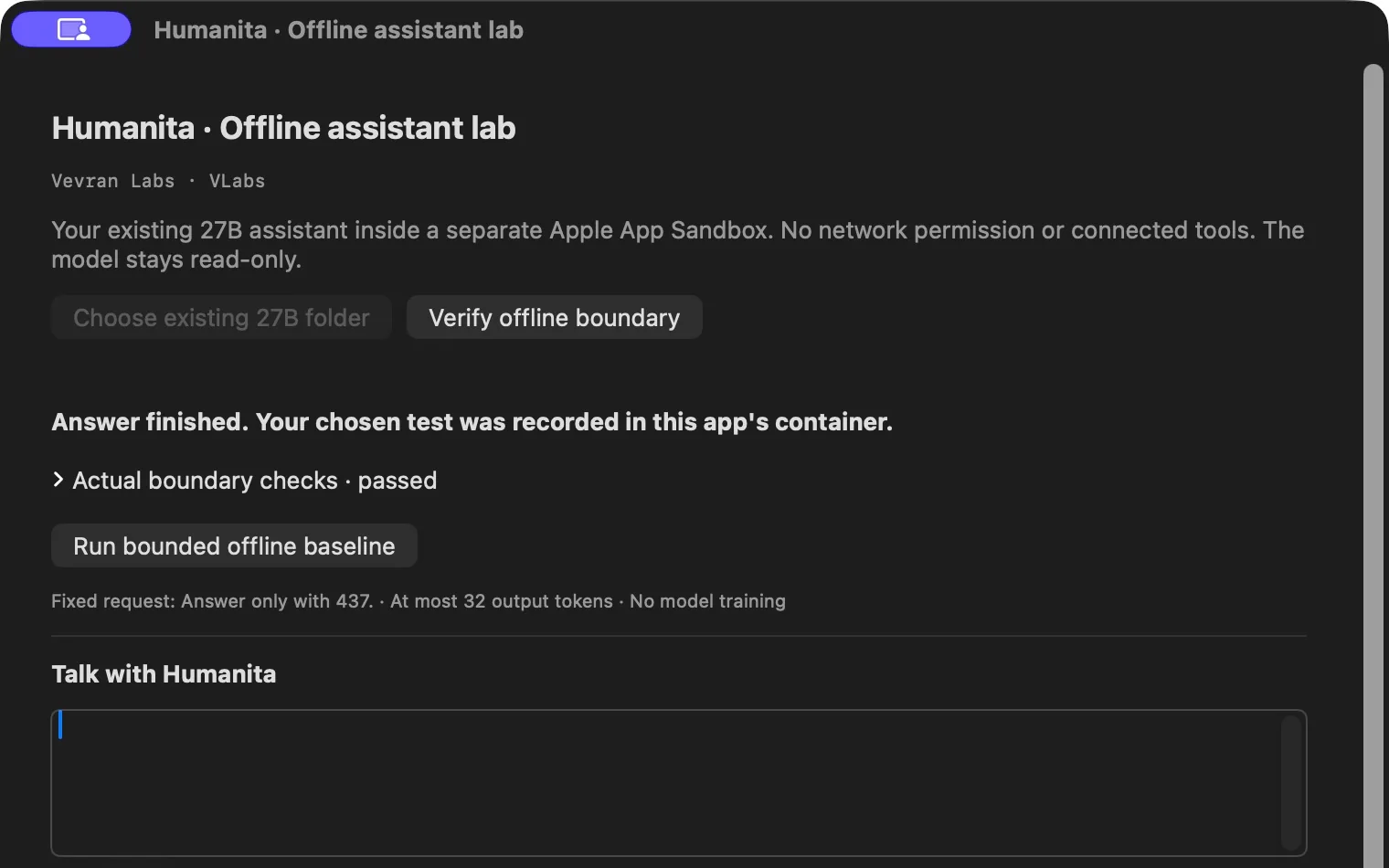
A private, offline Humanita assistant now runs on my Mac for testing, inside a locked-down app with no internet.
- 9/9 lockdown checks passed (Apple App Sandbox, no network)
- 19/20 practice coding and website tests
- 14/18 held-back tests it never saw before
Tests are synthetic and AI-written; not an intelligence score. The assistant runs on an existing open model; Humanita did not train its own.
Done
- A tiny teaching model, trained and tested (Sept 2026)
- An encrypted drive and a virtual practice computer with no network
- A safety-first plan and six behavior cases with 60 tests designed
- A private, offline Humanita assistant that runs an existing open-weight 27B model inside a locked-down Mac app (October 2026)
Not yet
- Any public release, download or account
- Its own trained model (the assistant runs on an existing open model)
- Internet, email or other connected tools
- Running the 60 behavior tests
- Planned products (Personal, Business, Security): design only
Talking with Codex, the AI assistant that helped build it, is not the same as talking with Humanita.
More details
- Understanding · Continuity · Agency
- Genesis 0, a practice network with 471 adjustable numbers
- 37 pages, with 40 checks it must pass
- Private and offline, on an existing open-weight 27B model (Qwen family)
Credits and notes
- Humanita is a project of Vevran Labs.